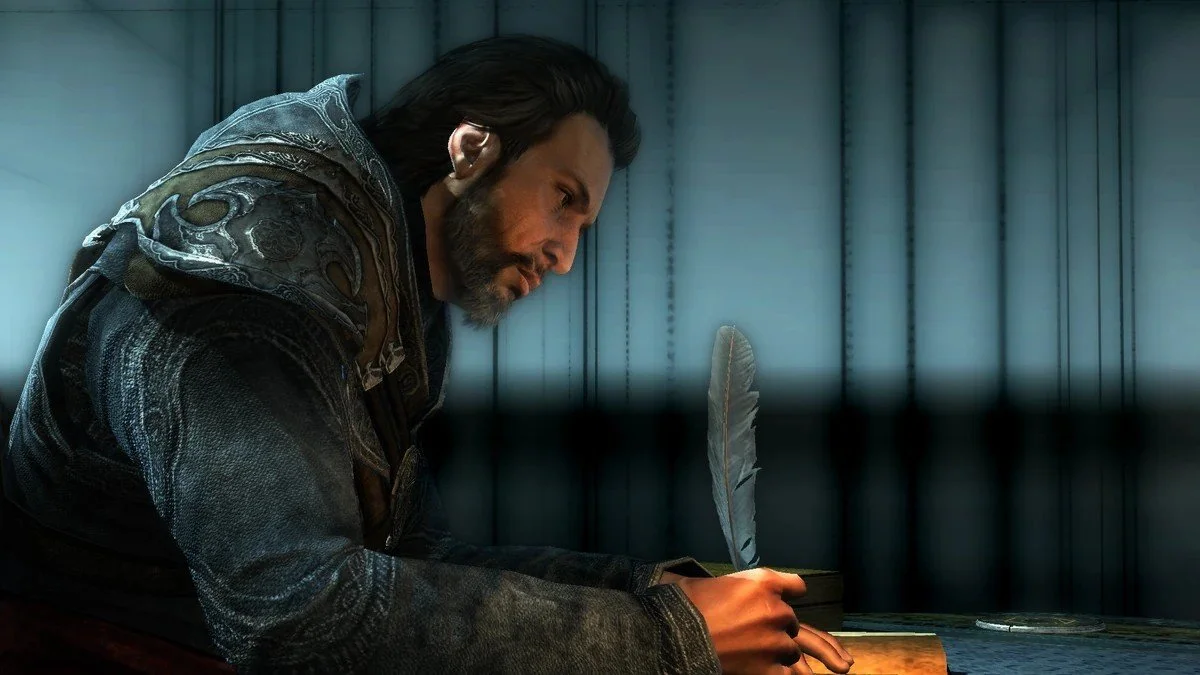
Assassin's Creed Revelations: Returning to Your Own Story
Sometimes a story comes along, and you become so invested that you just can’t stop until you reach the end. If it’s a series, that feeling can go even further. Maybe you’ve been following it for years of your life. Even the gaps between each subsequent addition can be filled with conversations online that maintain that series as a permanent fixture for as long as you let it.
But eventually that story comes to an end and you have to return to your own life.
Assassin’s Creed Revelations (2011) is the third and final game in the trilogy of Assassin’s Creed games that follow Ezio Auditore da Firenze in Renaissance era Europe. Through these games we see the majority of his life. His first appearance at the start of Assassin’s Creed II (2009) is literally his birth, and by the time we reach Revelations he’s in his 50s.
To this day, Ezio is the only historical assassin across the series to ever get more than one game, let alone a whole trilogy. It’s fitting than that this final entry is one about being so caught up in someone else’s story that you stop living your own.
Establishing the Meta
When looking at how Assassin’s Creed games are marketed, the focus in always on a historical setting. You can be a deadly warrior disguised as a scholar as you fight through the Holy Land during the Third Crusade (Assassin’s Creed [2007]). Or you can be a pair of twins pulling heists off moving trains in London during the Second Industrial Revolution (Assassin’s Creed Syndicate [2015]). Or you can be a mercenary in ancient Greece taking part is the battles of the Peloponnesian War (Assassin’s Creed Odyssey [2018]).
The historical settings are at the forefront of how these games are presented, but there is always an additional layer to it. Each of the mainline games are framed by having some variation of a character from the present living out the memories of a character in the past.
In many of these games, Assassin’s Creed Revelations included, the present-day character is one that is a fully developed and named. One game (Mirage) uses a few voice-over lines to provide the contextualization of a named present-day character. In some (Rogue, Black Flag, Unity, Syndicate) the present-day sections follow a first-person character who goes by only a nickname, making them more of an empty vessel for the player to embody. And finally, there are others (Liberation, Shadows) that take that latter idea even further and have the present-day implied through elements of the game, but the “character”, in so much as you can conceive of one, is the player themselves.
Even when this layer of the present is minimized in some of the games, its mere existence opens up a lot of possibilities for using it as a means of looking at how we engage with games and/or stories in general.
Looking at the first five games in the series, for example, we are a player, playing as Desmond Miles in the present, who is himself essentially playing as the historical Assassin. This creates a dynamic in which the way Desmond responds to the story is in conversation with the way the story can affect the player.
The “bleeding effect”, established in Assassin’s Creed II, is a hyperbolic literalization of this very idea. Desmond’s experience of Ezio’s life changes him. Where an audience member might have their eyes opened to different ideas after experiencing a story, Desmond is changed on a physical level, becoming a capable Assassin because he learned along side Ezio.
This concept of the present-day framing bringing a metatextual layer to the games in key to how I’d like to explore the story of Assassin’s Creed Revelations.
Let’s start by looking at the basic setup for this game.
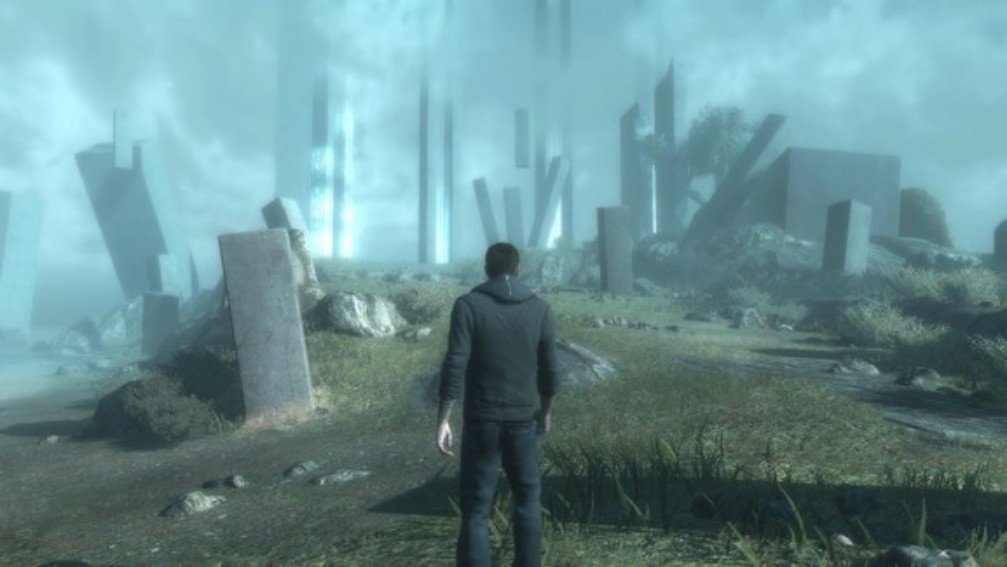
After the events of the previous game, Assassin’s Creed Brotherhood (2010), Desmond falls into a coma and is hooked up the Animus (the device that allows him to live out his ancestors’ lives). He is trapped within his own mind, with the Animus visualizing this state as being on a tiny island. This state has been brought on by spending too much time in the lives of others, leading to his mind becoming tangled and unable to differential his own life from that of Ezio’s, and Altaïr’s (the historical Assassin of the first game).
The solution? More time as Ezio:
“Here’s the problem. Your brain is hash. Too many ghosts in your head, too many voices. So how do you fix that? You claw your way back into the stored data, you find unfinished memories, and you crack them open. Finish what you started, until your ancestor has nothing left to show you.”
In other words, the only way to free himself from Ezio’s story is to reach the end of it.
Meanwhile, Ezio’s story for this game is centred on him chasing down Altaïr’s. We are first reintroduced to Ezio in a cinematic, where he explains that he has come to Masyaf Castle (home base of the Assassins in the first game), in order to find answers for his own life in the most apt place you can think of: a library.
“Today I have more questions than answers. This is why I have come so far: To find clarity. To find the wisdom left by the great Altaïr, so that I may better understand the purpose of our fight, and my place in it.”
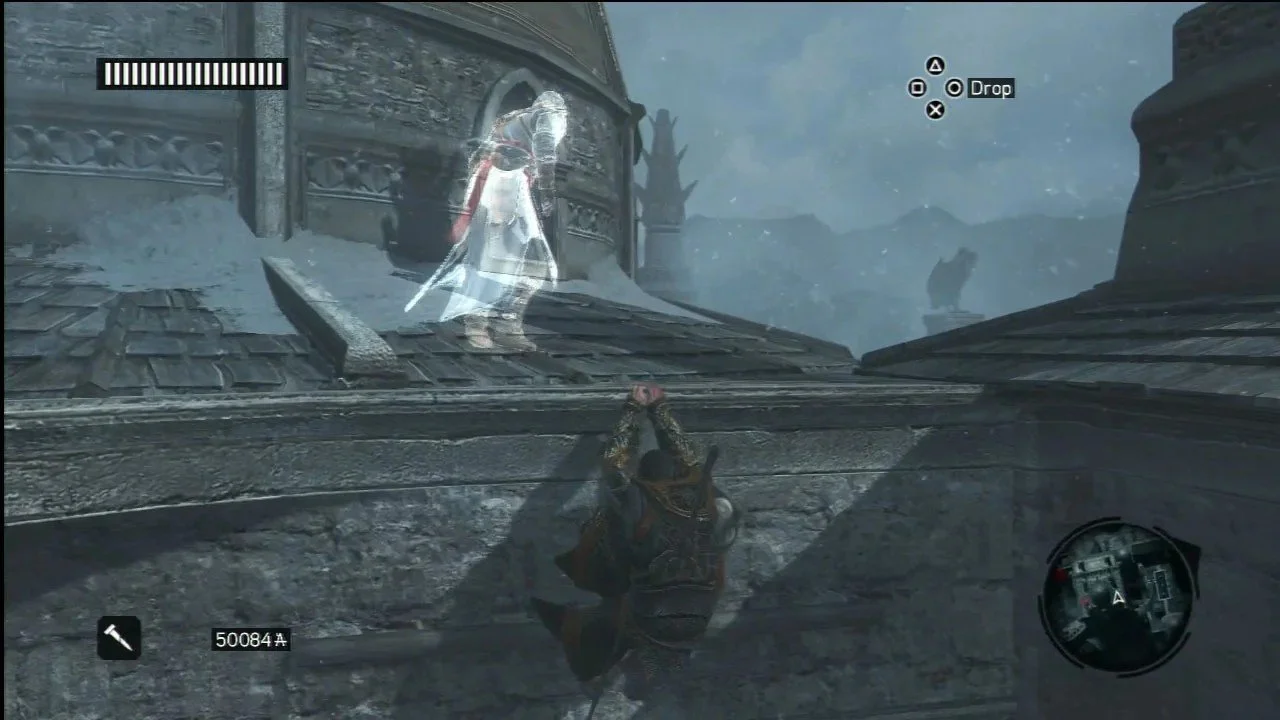
As we first take control of Ezio, we are given a tutorial on the game’s parkour and combat systems, during which we work our way up and through the castle while following the ghost of Altaïr. Ezio chasing Altaïr’s story is made a visual component in teaching us how to move around in the world of the game.
When Ezio finds the door to the library, it’s locked. After running down an enemy to collect a journal that once belonged to Niccolò Polo, Ezio learns the keys can be found in Constantinople. These keys, while we don’t know it yet, grant Ezio the ability to live out small portions of Altaïr’s memories.
So, basically this is a game where Desmond, our metatextual player insert character, needs to finish Ezio’s story. Ezio’s story is in turn about his needing to finish Altaïr’s story to find meaning in his life, something that he can only do by getting into a library.
Even the Templars, the shadowy enemies of the Brotherhood of Assassins, are after the same thing. Much like Ezio, they are looking for the keys so that they can find direction. Though where Ezio wants metaphorical direction, the Templars want literal directions to a Grand Temple.
Reaching Assassin’s Creed Revelations, players are likely to have played the previous two games in which Ezio is the historical Assassin and have become invested in where his story will go. In this first hour or so of gameplay, we are seeing Desmond in an extreme version of this same investment, where he cannot live his life until he finishes the story. And that story, is one of looking to stories in search of meaning for your own life.
As the game goes on, Ezio goes even further in this direction. While his primarily goal in the game is to enter the library and learn what he can from Altaïr’s story, he finds the time to partake in the stories of many others.
An Open World of Stories
It’s easy to imagine a setup like this, where a character is trapped because of their need to finish a story, leaning in the direction of the dangers of going too deep into fiction or some other kind of cautionary tale. Instead of this, Assassin’s Creed Revelations often focuses on the joy of partaking in stories, and even links ideas of gathering books with romance.
Niccolò Polo’s journal leads Ezio to his old trading post, which has now become a bookshop belonging to Sofia Sartor. Beneath it, Ezio finds a map, but requires Sofia’s help to decipher it. The only way she can do that? By first having Ezio collect rare books referenced around the margins.
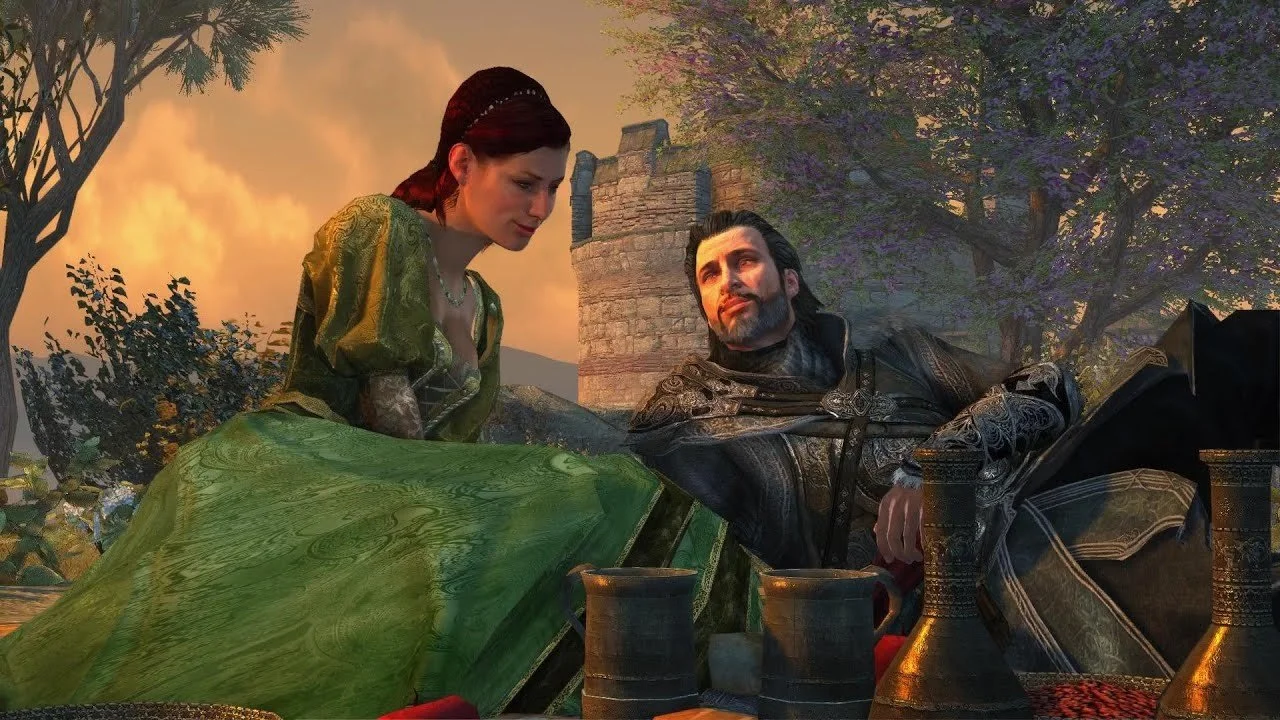
Sofia is Ezio’s love interest in the game, as well as being his partner in looking for these keys. While these points make her important to the plot, it’s her connection to books that makes her especially interesting for my purposes here.
Through Sofia, Ezio’s feelings of love intertwine with his work hunting down books. For Ezio, gathering these are stepping stones on his journey, but Sofia’s purposes go beyond how they can help either of them. Sofia makes it clear that one of the reasons she agrees to help Ezio is so she could reprint the rare books he finds and make them accessible to the public.
Ezio is looking to stories to find answers about his own life, and this search is opening the possibility for others to do the same.
And this is still just getting started. Books and the stories of others are a constant fixture throughout this game.
A small touch that pushes this idea forward is the use of merchants and purchasable collectables. Where Ezio’s previous two games included art merchants, allowing Ezio to fill his bases with famous Renaissance artwork, this game replaces those with merchants who sell books.
Then there are the new assassin’s that Ezio is recruiting. Where Assassin’s Creed Brotherhood created this mechanic to summon new recruits in combat, or send them on missions to level them up, they were ostensibly faceless. In Revelations, these Assassins can be put in charge of their own sections of the city, with Ezio aiding them in a series of missions to keep it safe. They’re the main characters in their own stories, and Ezio is there to help them succeed rather than control them.
Even the major political plot in Constantinople is less about Ezio than his past games have been. In both Assassin’s Creed II and Assassin’s Creed Brotherhood, Ezio’s involvement in their respective cities stems from a place of personal revenge. He is travelling to these places because Templars have killed his family, and now he will stop and nothing to put an end to their plots.
In this game, Ezio doesn’t have that personal connection at all, and the story he finds himself interacting with is one focused on another family all together. This is about the succession of the Ottoman Empire and preventing the conspiratorial actions that would give control to one family member of the other. When we reach the end of Ezio’s time in Constantinople, he’s not even the one who kills the final Templar, that honor goes to Yavuz Sultân Selim Khan.
And at this point something should be becoming clear: every one of Ezio’s plots in this game are about his participation and search for the stories of others.
Where Sofia is instilling this idea of the beautiful of stories and the joy of sharing them, Ezio’s manages to be more separated from his own story than even Desmond is.
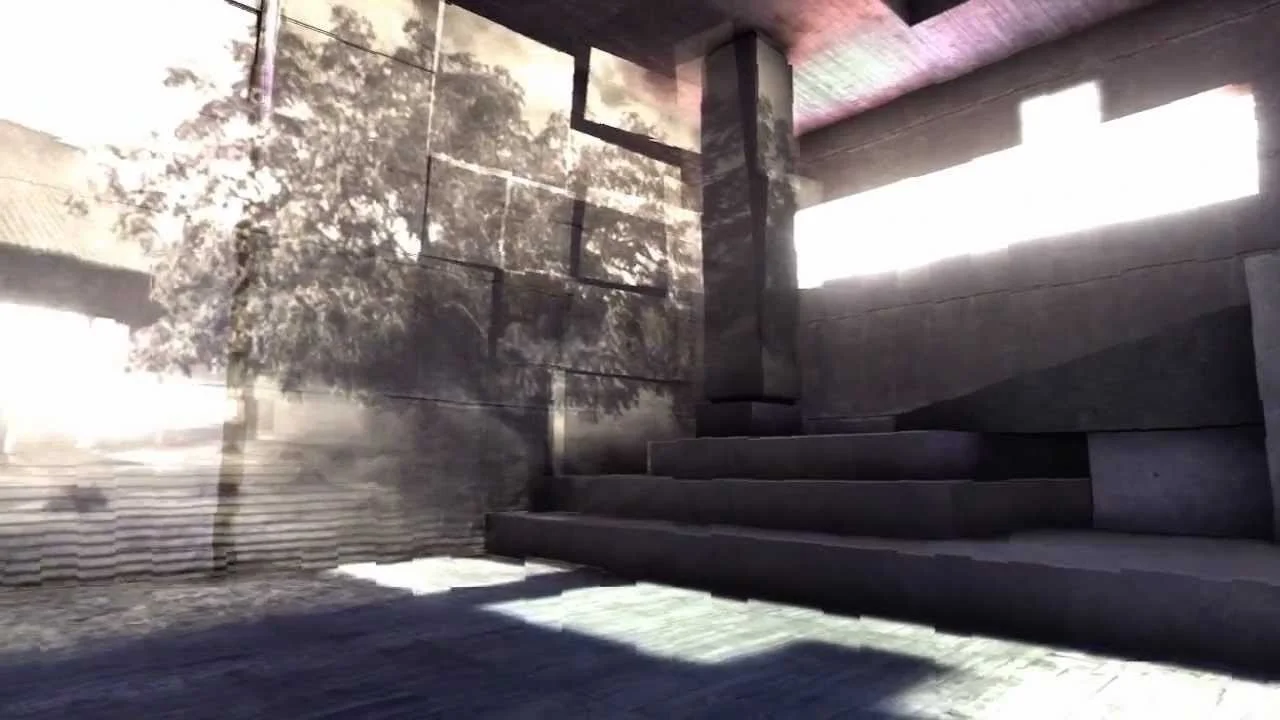
While Desmond can’t wake up until he finishes Ezio’s story, he can – fairly literally – walk through his own memories. There are five optional missions in which the player takes on a first-person perspective, moving through something between a walking simulator and a puzzle game while his memories play out loud.
Contrasting this, Ezio is making an active choice to keep his life from Sofia for fear of what will happen if she becomes too much a part of it. Of course, this doesn’t work out very well, and she ends up kidnapped by the Templars anyway. He is forced to choose between the keys to the library and Sofia’s life, and he chooses Sofia… and then immediately chases down the Templar with Sofia by his side.
We can see the moment of Ezio’s deal as one where Ezio is making the choice of having a life of his own rather than a life as an Assassin. We can evidence of the fact that he sees these things as mutually exclusive soon after he explains his life to Sofia, when they have this exchange:
Sofia – “Do you regret your decision? To live as an Assassin for so long?”
Ezio – “I do not remember making that decision. This life, it chose me.”
Having made this choice, and now having all the keys in his possession, Ezio is ready to put down the story of the Brotherhood of Assassins. Where better to leave it than inside of a library?
The Library
As we reach the final section of the game, there is a beautiful mirroring with the beginning. We started the game with Ezio chasing Altaïr’s ghost through the Masyaf Castle, spurred on by the need to know Altaïr’s story. Now Ezio walks slowly through it with Sofia at his side, telling her about the Assassins and how his story became theirs.
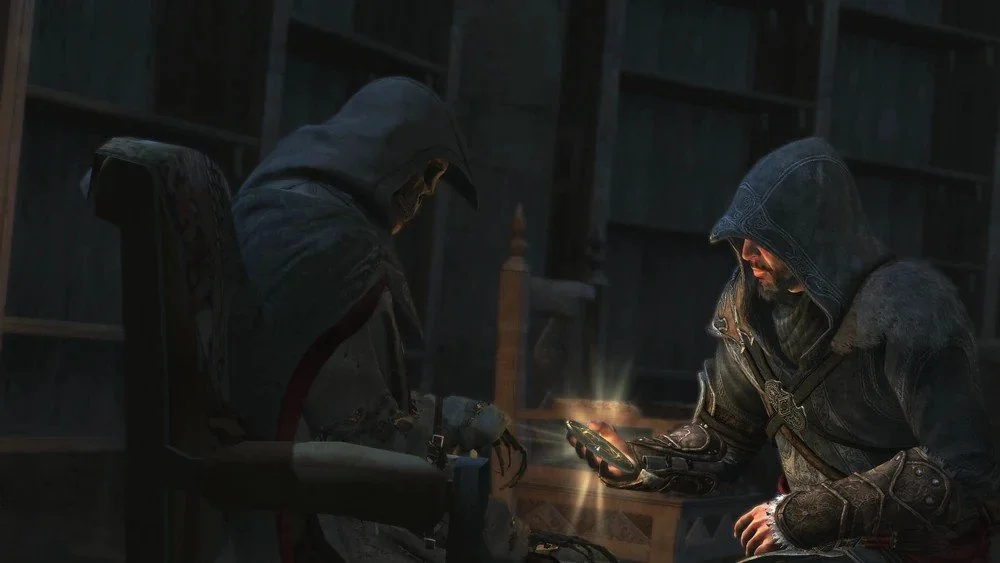
Ezio enters the library by himself, and here he finds that there are no books at all, just Altaïr’s body. The library he has been seeking is revealed to be more of a mausoleum, a fitting metaphor when the game is comparing lives to stories.
With Altaïr’s body is one last memory for Ezio to see. In it, Altaïr steps into the library, putting out all the torches as he slowly makes his way deeper into the room, a reversal of Ezio, who just lit all the torches while doing the same walk. These torches come represent the intent of those entering this space, coming to either snuff out their story or ignite it.
Ezio finds the Apple of Eden, an ancient artifact of great power, but does not wish to touch it. Instead, he calls out to Desmond as he begins removing his weapons.
"I have lived my life as best I could, not knowing its purpose, but drawn forward like a moth to a distant moon. And here, at least, I discovered a strange truth: that I am only a conduit for a message that eludes my understanding. Who are we, who have been so blessed to share our stories like this? To speak across centuries? Maybe you will answer all the questions I have asked. Maybe you will be the one to make all this suffering worth something in the end."
Looking at this speech through the lens of the meta, with Desmond standing in the for the audience playing the game, we can read this speech as Ezio’s acknowledgement of his own fictionality. His life has been lived in such a way as to impart something upon an audience that he will never know, and he just hopes that they will take something from it.
At the end of his speech, Ezio touches this vision of Desmond, allowing Desmond to see a big exposition dump from Jupiter, a part of the “First Civilization” (or Isu, as later games will come to call them), a race of beings that created humans.
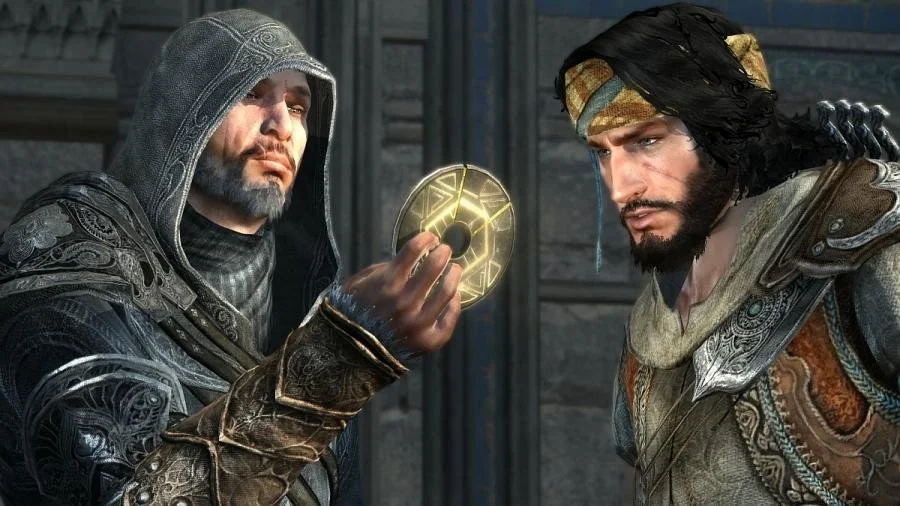
For the purposes of this piece, the exact details of what are said don’t particularly matter. What matters is that after reaching the end of Ezio’s story, our metatextual player insert character is touched, and appears to receive a message directly from a creator, something that can help them better live their life.
It’s taking this idea of internalizing themes, messages from an author, and turning it into something more literal and actionable because we’re in a sci-fi action series.
At this point, Desmond wakes up. Just like Ezio putting down the story of the Assassins to life his own life, Desmond is able to escape Ezio’s story and return to his own life. And thanks to the ideas he found in Ezio’s story, he knows what he can do to save the world.
And Ezio, his story done, moves on. There is a short, animated film, Assassin’s Creed: Embers (2011), that gives us a final end to Ezio’s story, but we don’t see him again in this game. He’s left the Assassins, the purview of the story. The ideas that started with Altaïr are returned to the library, that book is done, and he can move on.
Putting the Story Down?
Assassin’s Creed Revelations is not only the end of Ezio’s trilogy, but it’s penultimate game in the Desmond era of games. The way this game puts so much emphasis on finishing stories and being able to walk away with new lessons brought to your life, feels like it is just as much preparing us to say goodbye to Desmond.
Just like Ezio was able to leave this story behind, just like Desmond was able to wake up after finishing it, when we reach the end we should go out create stories of our own.
Writing about this in mid 2026 does feel like some irony has been placed on everything I read into this game. Assassin’s Creed Black Flag Resynced, a remake of one of the most popular games in the series is about to come out. Not only that, but rumours about the next game, currently known as Assassin’s Creed: Codename Hexe, are claiming that the main character is a descendant of Ezio’s sister, Claudia, and that he will in some way play a role in this game. It’s funny to talk about a game themed around moving on from finished stories, knowing that the developer of these stories is currently going the opposite route.
I’m not entirely against either of these things. There are ways to do incredibly cool stuff by bringing back ideas from the past. Assassin’s Creed Valhalla (2020) uses tons of references to past games to make a story about cycles, and Assassin’s Creed Mirage (2023) plays with the themes of the original Assassin’s Creed, but with a reversal of the protagonist’s character arc. Supposedly, Assassin’s Creed Black Flag Resynced has completely redone its connection to the present-day, and that alone could open up some interesting possibilities of what it means to revisit a story after the context of your life has changed.
That said, these choices coming back-to-back for the upcoming games do still feel notable. This is a series built on reinvention. Nearly every game is a grand new set of characters in a completely different time and place. We’ve seen experiments with how to use the present-day sections. There was even a total reinvention of the style of gameplay the series works in, beginning with Assassin’s Creed Origins (2017).
While I remain hopeful, only time will tell what this current direction means. Will the familiar will be used to create something new, or will we find ourselves back on Animus Island, unable to move on from stories we finished long ago?